You passed the class. Maybe you passed it well. The material made sense at the time, the exam went fine, and you moved on. But six months later, sitting down to study for a cumulative exam, you discover that most of what you learned has quietly disappeared. Terms you once defined with confidence are gone. Concepts that felt solid now feel unfamiliar. You're not building on a foundation — you're rebuilding from the ground up, and it's hard to understand where all that effort went.
This is one of the most common and most frustrating experiences in education. And it's not a personal failing. It's a well-documented feature of how human memory works, one that's been measured with remarkable precision for over 140 years.
The Shape of Forgetting
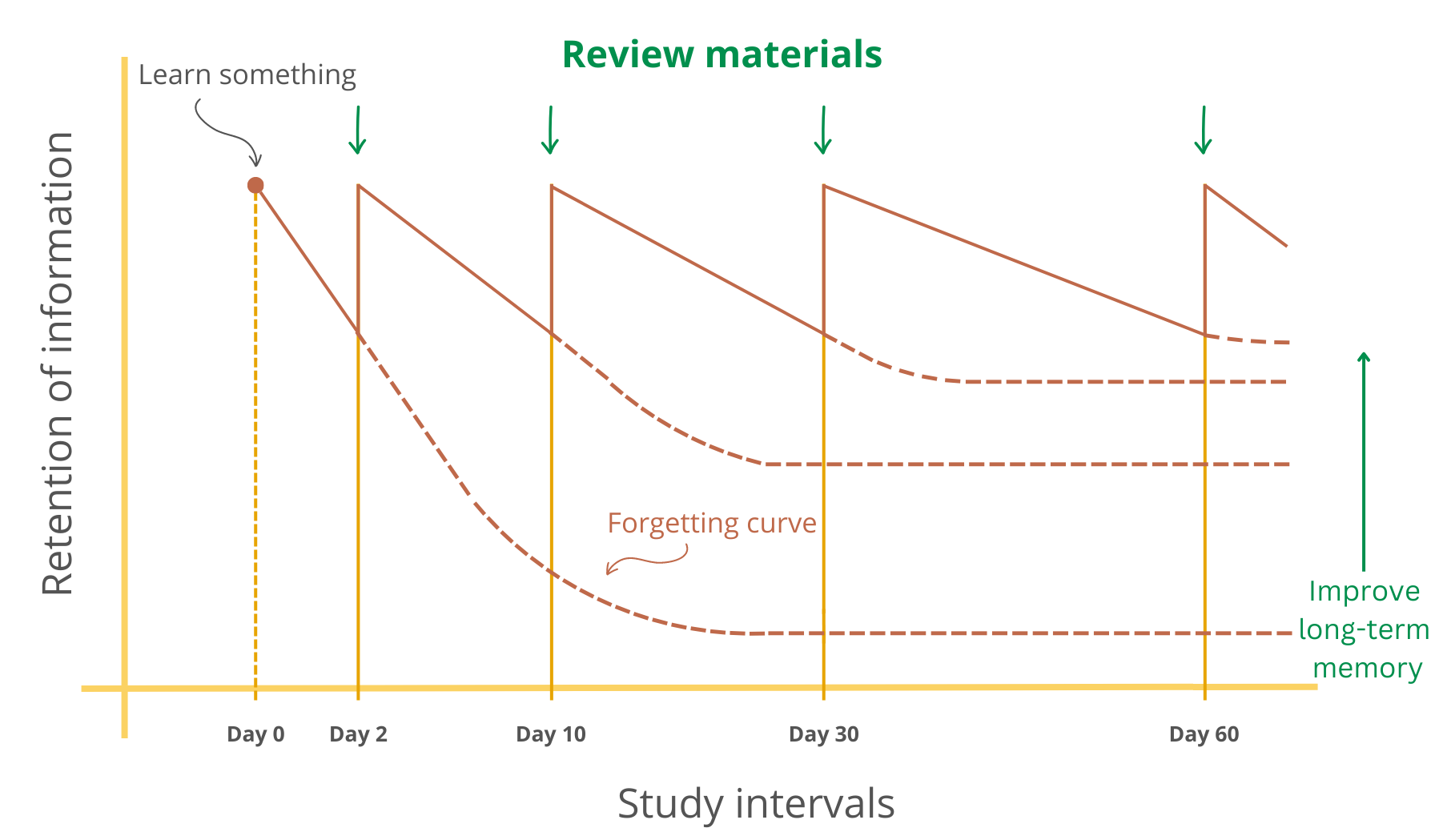
In the 1880s, a German psychologist named Hermann Ebbinghaus set out to measure something no one had systematically measured before: how quickly we forget. He memorized lists of nonsense syllables, meaningless letter combinations deliberately stripped of any helpful associations, and tested himself at intervals from twenty minutes to a month. The pattern was striking. Retention dropped steeply in the first few hours, then continued to decline at a gradually slowing rate over subsequent days and weeks. The result was what researchers now call the forgetting curve: fast loss early, slower loss later, but loss nonetheless.
Ebbinghaus worked alone, using himself as both experimenter and subject, and his materials were deliberately meaningless. Those are real limitations. But the basic shape has proven remarkably durable. In 2015, a team at the University of Amsterdam replicated his experiment faithfully. One subject spent roughly 70 hours across 75 days learning and relearning lists of nonsense syllables, tested at the same intervals Ebbinghaus used. When the replication data were overlaid with Ebbinghaus's original results and two earlier replications from different countries, the four curves converged closely, despite spanning more than a century and four different individuals.
The specific steepness varies from person to person and from material to material. Meaningful, well-connected information resists forgetting more effectively than meaningless syllables. But the general pattern holds. Without deliberate reengagement, newly learned information becomes progressively harder to retrieve, and it does so faster than most learners expect.
Why Your Confidence Is Misleading
Here's where the problem compounds. Not only do we forget quickly, we're also systematically wrong about how much we'll forget.
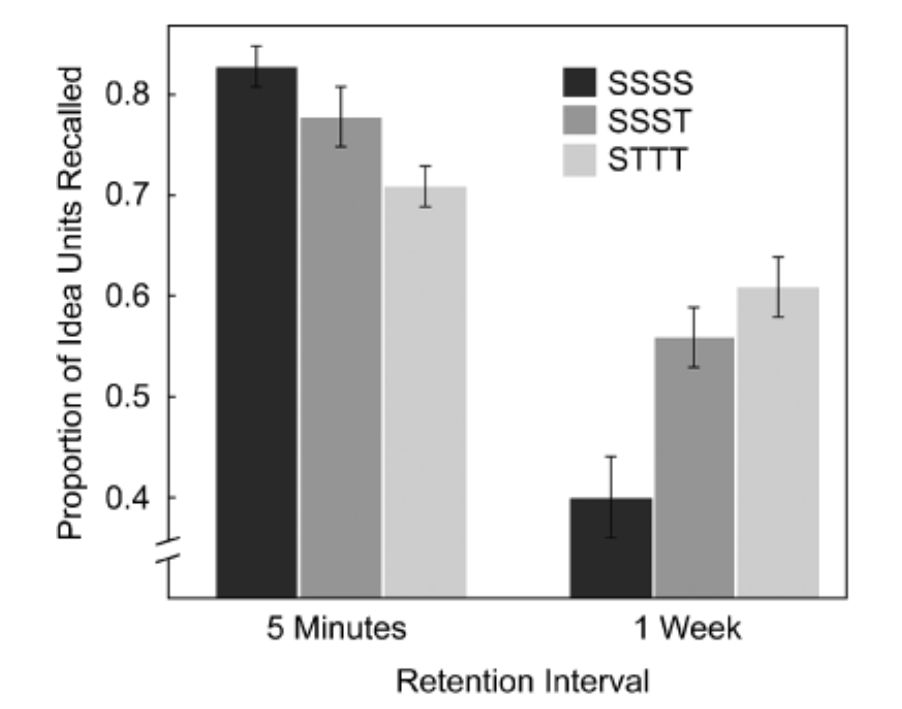
Roediger, H. L., & Karpicke, J. D. (2006)
In a series of experiments at Washington University, students learned prose passages under different conditions. Some reread the passage four times. Others read it once and then practiced recalling it three times. The rereading group (“SSSS”) encountered the full text an average of 14 times across their study periods. The recall-practice group (“STTT”) encountered it about 3 times. When tested five minutes later, the group that reread four times performed best, which is what most students would predict. But when tested one week later, the pattern reversed: the group that practiced recall retained substantially more, despite having spent far less total time looking at the material.
The most revealing part of the study wasn't the retention data, it was the confidence ratings collected after the learning phase. Students in the rereading condition predicted they would remember the passage best. Students in the testing condition predicted they would remember it worst. The group most confident about their future memory had the poorest actual retention. The group least confident had the strongest.
This isn't a minor calibration error. It's a systematic inversion, and it happens because learners mistake current fluency for future durability. Right after studying, the material feels accessible. It's fresh, it's recognizable, and that sense of familiarity generates confidence. But familiarity and durability are not the same thing, and confusing them is one of the most consequential mistakes a learner can make.
Retrieval Strength vs. Storage Strength
A framework developed by Robert and Elizabeth Bjork helps explain why this illusion is so persistent. They distinguish between two properties of any memory: retrieval strength, which is how easily you can access it right now, and storage strength, which is how deeply it's embedded and interconnected with other things you know.
These two properties can move independently, and that independence is what makes intuition about learning so unreliable. Right after a study session, retrieval strength is high. The material is fresh and feels solid. But if the encoding was shallow (like a single pass through lecture slides, a quick reread of the chapter) storage strength may be low. The information will fade fast even though it feels stable in the moment.
The steep initial drop on the forgetting curve reflects exactly this: the rapid decay of retrieval strength for material that was encoded only once and only recently. But here's the critical nuance — forgetting is often a failure of retrieval, not a loss of the underlying trace. The 2015 replication demonstrated this directly. Material that subjects could no longer freely recall still showed measurable advantages when they went to relearn it. The original learning had left a trace that made reacquisition faster, even when the information seemed completely gone.
This matters because it means the situation is not hopeless. The knowledge isn't erased. The problem is access, and access can be maintained.
Fighting the Curve
The strategies with the strongest evidence for counteracting forgetting share an uncomfortable feature: they feel harder than the alternatives.
Spaced practice distributes study across time rather than concentrating it in a single session. By allowing some forgetting to occur between encounters with the material, you force deeper reprocessing each time you return to it. A large study with over 1,350 participants found that the optimal gap between study sessions depended on how long the learner needed to retain the material. For a test a week away, spacing study sessions about a day apart worked best. For retention across several months, gaps of several weeks were optimal. The most practically important finding was an asymmetry: the cost of spacing too narrowly — reviewing again while the material is still fresh — was far greater than the cost of spacing too widely. Reviewing too soon is a bigger mistake than waiting too long.
That finding alone should give every student pause. The instinct to review material while it still feels accessible is precisely the instinct that produces the weakest long-term retention.
Retrieval practice means testing yourself rather than rereading. When you force your brain to reconstruct information from memory rather than simply reexposing it to the material, the effort of that reconstruction strengthens both the trace and the pathways used to reach it. This is how students who read a passage 3 times and tested themselves outperformed students who read it 14 times. The testing group did less studying and more remembering, and that made all the difference a week later.
Both of these strategies will get their own dedicated posts in this series. For now, the point is that the forgetting curve is not a passive observation. It's a problem with known, well-tested countermeasures, and those countermeasures require doing the opposite of what feels natural.
“The gap between what I thought I knew and what I could actually retrieve was enormous”
What This Looked Like for Me
I experienced the forgetting curve before I knew it had a name. When I sat down to study for the MCAT, I expected to be building on four years of college coursework. I had taken the classes. I had passed them, many of them with good grades. But when I opened the review materials, the experience wasn't review, it was relearning. Concepts I had once understood felt foreign. Pathways I had once traced through confidently were gone. The gap between what I thought I knew and what I could actually retrieve was enormous, and the preparation felt like starting from scratch despite years of prior coursework.
What made that experience so frustrating wasn't the difficulty of the material. It was the realization that all those hours of studying in college hadn't produced knowledge that lasted. I had performed well on course exams (tests that came days or weeks after studying), but the learning hadn't been built to endure across months and years.
When I entered medical school, I changed my approach. Not just one thing, but the entire system. I started spacing my reviews deliberately instead of cramming. I replaced rereading with self-testing. I stopped trusting how familiar something felt and started tracking whether I could actually produce it from memory. By the time I was preparing for board exams, I was covering dramatically more information under arguably higher stakes, yet the experience felt fundamentally different. I was more comfortable, more confident, and more in command of the material. This was not because I had studied harder, but because I had studied in a way that was designed to resist the curve.
The Core Lesson
The forgetting curve tells you something every learner needs to hear: your memory is not self-maintaining. Without deliberate reactivation, even well-formed knowledge becomes progressively harder to access. The speed of that decline depends partly on how well you encoded the material in the first place. Shallow, single-exposure learning produces the steepest drop, while deeper, more connected encoding resists forgetting more effectively. But even strong initial encoding is not enough on its own. Durability has to be engineered across time.
The good news is that the engineering is well understood. The strategies exist, the evidence is strong, and they're available to anyone willing to trade short-term comfort for long-term retention. The next post in this series covers the one of the most effective tools for fighting the curve: retrieval practice.
AceMedEd
This post is part of a series on the science of learning. Each post covers one evidence-based principle and how to apply it to your own studying. Follow us on Instagram @acemeded to keep up with future blog posts and related content
References
Bjork, R. A., & Bjork, E. L. (1992). A new theory of disuse and an old theory of stimulus fluctuation. In A. Healy, S. Kosslyn, & R. Shiffrin (Eds.), From learning processes to cognitive processes: Essays in honor of William K. Estes (Vol. 2, pp. 35–67). Erlbaum.
Cepeda, N. J., Vul, E., Rohrer, D., Wixted, J. T., & Pashler, H. (2008). Spacing effects in learning: A temporal ridgeline of optimal retention. Psychological Science, 19(11), 1095–1102.
Murre, J. M. J., & Dros, J. (2015). Replication and analysis of Ebbinghaus' forgetting curve. PLoS ONE, 10(7), e0120644.
Roediger, H. L., & Karpicke, J. D. (2006). Test-enhanced learning: Taking memory tests improves long-term retention. Psychological Science, 17(3), 249–255.
Wollstein, Y., & Jabbour, N. (2023). Spaced effect learning and blunting the forgetfulness curve. Ear, Nose & Throat Journal, 101(9S), 42S–46S.
