Here is a finding that should change how you study: reviewing material too soon after learning it is a bigger mistake than waiting too long.
In a study of over 1,350 participants tested across gaps ranging from zero to 105 days, researchers mapped the relationship between when people reviewed and how much they remembered later. Performance improved steeply as the gap between study sessions increased from zero, then declined much more gradually past the optimum (Cepeda et al., 2008). The curve was lopsided. Cramming (reviewing while the material is still fresh) sat at the worst end of the distribution. Waiting somewhat too long produced only a modest decline. The asymmetry was clear and consistent: if you're going to err, err on the side of waiting longer.
This runs directly against the instinct most learners follow. When something is fresh, reviewing it feels productive. The material comes back easily, recognition is high, and the session feels efficient. But as the first post in this series showed, that sense of fluency is a poor indicator of durability. And as the second post demonstrated, the strategies that feel hardest often produce the strongest retention. Spaced repetition is the scheduling principle that ties these ideas together — and it carries one of the deepest evidence bases in all of learning science.
The Biology of Why Timing Matters
The reason spacing works is not that you need rest between sessions. If rest were the explanation, any break would do, and the specific duration of the gap wouldn't matter. It does matter, and the reason involves what your brain does between study sessions rather than during them.

When you first learn something, that memory depends heavily on the hippocampus — a brain structure that coordinates initial encoding and early stabilization. Over the hours and days that follow, particularly during sleep, that memory is progressively reorganized and integrated into broader cortical networks. Neuroscientists call this process systems consolidation, and neuroimaging studies show its signature: when learners encounter the same material in a later session, the hippocampus re-engages, and brain activity looks more like initial learning than like within-session repetition (Van Hoof et al., 2021). Within a single session, by contrast, the brain processes each repetition less exhaustively than the one before. Additional same-session repetitions offer diminishing returns for long-term retention.
At the molecular level, the pattern is consistent. In studies of long-term potentiation in rat hippocampal slices, successive rounds of stimulation need to be spaced by roughly 40–60 minutes to produce cumulative strengthening; stimuli arriving sooner fall within a refractory period where the signaling cascades that consolidate synaptic changes have not yet reset (Smolen et al., 2016). Similar refractory dynamics appear in other model systems, though the specific timescales vary with the organism and the type of learning involved. The spacing effect is not merely a behavioral regularity observed in psychology experiments. It reflects identifiable biological processes, even if the precise timescales differ across preparations.
A complementary account comes from work on memory reconsolidation. When a consolidated memory is retrieved, it appears to re-enter a temporarily unstable state where it can be modified and then re-stabilized, a process that can strengthen the memory and update it with new information (Smith & Scarf, 2017). From this perspective, each spaced study session doesn't simply add another exposure. It reactivates prior learning and triggers a fresh consolidation cycle. Massed practice short-circuits that cycle by presenting new exposures before the preceding consolidation has had time to take hold.
These mechanisms are complementary rather than competing. Consolidation, reconsolidation, and molecular refractory periods likely all contribute to the spacing effect, operating at different timescales and levels of analysis. The research hasn't definitively settled which mechanism dominates, but the convergence across behavioral, neuroimaging, and molecular evidence is unusually strong for a learning strategy.
“the convergence across behavioral, neuroimaging, and molecular evidence is unusually strong for a learning strategy.”
How Long Should You Wait?
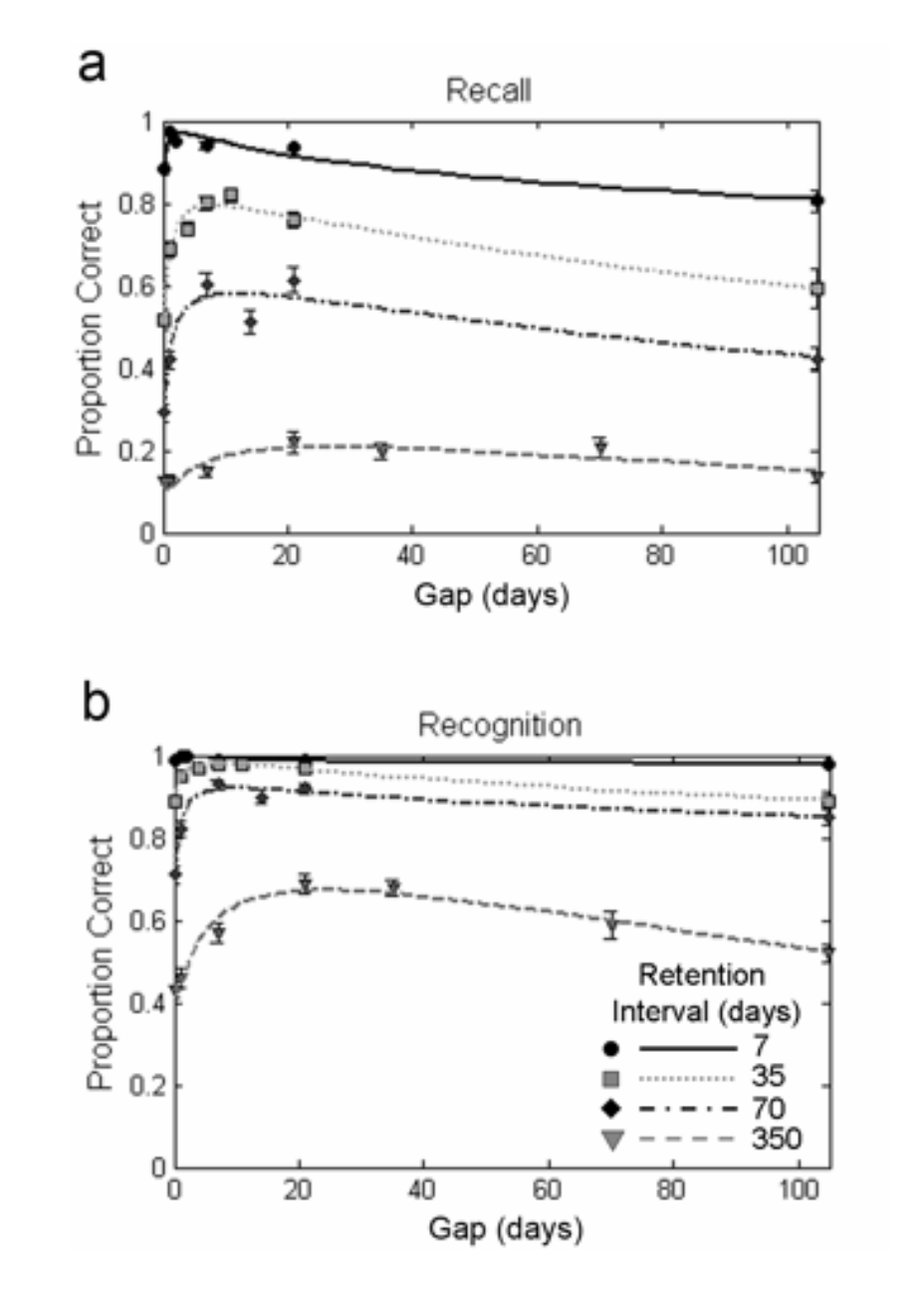
The answer depends on how long you need to remember the material, and the relationship is not linear.
Cepeda et al. (2008) systematically tested participants across 26 combinations of study gaps and retention intervals. For a test one week away, a gap of about one day produced the best retention. For a test a month away, the optimal gap was closer to a week and a half. For retention spanning several months, gaps of several weeks worked best. The ratio of optimal gap to retention interval declined as the interval grew longer, which means the scaling is not proportional. You don't need to double the gap every time you double the target retention period.
The practical takeaway is more straightforward than the numbers suggest. If you need to remember something for a month, review it about a week after you first study it. If you need it for a year, wait several weeks before your first review. These are approximations, but they are far closer to optimal than the common approach of reviewing intensively right before the material is needed.
And this is where the asymmetry finding becomes genuinely useful. Because the cost of spacing too narrowly is much steeper than the cost of spacing too widely, a learner who is unsure about when to review is almost always better off waiting a bit longer. The impulse to review while the material still feels fresh is precisely the one that produces the weakest long-term retention.
Why Spacing Doesn't Feel Like It's Working
If you've tried spacing and found yourself doubting the approach, that reaction is actually predicted by the research.
For verbal and factual learning in adults, spacing typically does not improve how much you know at the end of a study session. Massed practice often produces equivalent or even slightly better immediate scores (Smith & Scarf, 2017; Cepeda et al., 2006). The advantage of spacing emerges only on delayed tests, when spaced learners consistently outperform those who crammed. During the session itself, spacing can feel less efficient. You forget more between encounters, retrieval is harder, and the material doesn't come back as smoothly as it would after concentrated review.
This is the same performance-versus-learning dissociation that appeared in the retrieval practice post. The strategies that produce the strongest long-term retention are the ones that feel least productive in the moment. Immediate fluency is not the same as durable learning, and confusing the two leads learners to abandon effective strategies in favor of approaches that feel smoother but retain less.
The pattern shifts for motor and procedural skills, in a way that matters for anyone in clinical training. Surgical residents who practiced microvascular anastomosis across weekly sessions performed comparably to a massed-practice group immediately after training. But one month later, the spaced group performed substantially better on both a retention test and a transfer test using a live surgical model, a context neither group had practiced in (Moulton et al., 2006). The transfer result is notable because it suggests spacing didn't just slow forgetting. It produced a more flexible representation of the skill, one that held up when the setting changed.
“Immediate fluency is not the same as durable learning, and confusing the two
leads learners to abandon effective strategies”
Boundary Conditions Worth Knowing
Spacing is among the most reliable findings in learning science, but it has limits that matter for how you apply it.
Each session needs to be substantial enough to produce learning. Research on perceptual and skill-related tasks suggests that a minimum threshold of experience per session is necessary for learning to occur (Smith & Scarf, 2017). For example, in perceptual discrimination tasks, participants who received too few trials per day showed no improvement regardless of how many days they practiced (Wright and Sabin, 2007, cited in Smith & Scarf, 2017). The threshold varies by task, but the principle is worth keeping in mind: distributing learning across many very brief sessions can fragment the experience to the point that no individual session generates enough engagement to drive learning forward.
Spacing is a scheduling principle, not a learning activity. What you do during spaced sessions matters as much as when you do them. Distributing passive rereading across multiple days is better than cramming that rereading into one sitting, but it falls well short of distributing retrieval practice across the same schedule. When spacing combines with active retrieval, the result is the strongest retention of any arrangement tested in the research (Dobson et al., 2016). Spacing amplifies productive study methods. It does not substitute for them.
The evidence for transfer is encouraging but limited. The Moulton et al. surgical training study found spacing advantages on a transfer task, and studies with children show that spacing supports complex generalization. But the number of adult studies directly testing spacing's effect on transfer remains small (Smith & Scarf, 2017). The theoretical case is coherent — the same consolidation processes that support retention are the ones linked to generalization — but transfer should be treated as a plausible benefit rather than a confirmed one.
What This Looked Like for Me
When I started medical school, I was actively trying to develop the most effective study strategy. Building upon my college experiences and advice of faculty and peers, it seemed that this would involve pre-reading lecture material, attending and actively participating during lectures, reviewing my lecture notes the same evening, and then re-reviewing in the days that followed. On the surface this seemed reasonable. After all, seeing the material that many times surely had to lead to successful learning, right?
I tried this method as the year began, but gradually shifted as it felt like my understanding and retention didn't match my effort. At the same time, I was testing out various other strategies from online resources: active recall, spaced repetition, and many of the other principles we will outline in this blog. The contrast was hard to ignore. Content for which I used these strategies was sticking in a way that the read-and-reread material simply wasn't. And not just marginally so; I felt like I was truly building command of the material, rather than cycling through it.
The central tool in that shift was Anki, a flashcard application built around spaced repetition. The software automates the scheduling, surfacing cards at expanding intervals based on how well you recall them. Beyond its utility in studying for our regular in-house exams, which came around every 2-3 weeks, Anki was instrumental to my broader study plan: a strategy that would allow me to prepare for my STEP 1 exam gradually. This exam was planned two years after the start of my medical school studies, and as I described in the first post in this series, I didn't want to be approaching it with the same feelings I encountered during my MCAT prep.
When I sat down to begin my "dedicated period" (a stretch free of coursework that medical students are granted by their schools to prepare solely for their board exams), the difference was unmistakable. Material I had first encountered over 18 months earlier was still accessible. Dedicated felt less like a panicked sprint and more like a refinement of knowledge I already owned. Over time, I learned to recognize the uncomfortable feeling of partial forgetting not as a sign that spacing wasn't working, but as the mechanism doing precisely what the research predicts.
Trusting the schedule when it felt wrong was the hardest part. The instinct to review material while it still felt accessible was strong, and resisting it felt like neglect. In hindsight, that instinct was the single most costly habit I had to break.
“Content for which I used these strategies was sticking in a way that the read-and-reread material simply wasn't.”
The Core Lesson
Spacing works because it acknowledges a fundamental property of memory: durability is not created by overexposure during a single session. It is created by allowing your brain to consolidate memories between encounters, then retrieving those partly-forgotten memories under conditions that force genuine reconstruction. The interval between sessions is not dead time. It is when the molecular, cellular, and systems-level changes occur that transform fragile knowledge into durable understanding.
The inverted-U relationship tells you that spacing can be too narrow or too wide, but the asymmetry tells you which error is worse: too narrow, by a large margin. If you need to remember material for a month, space your reviews about a week apart. If you need to remember it for a year, space them several weeks apart. These approximations beat careful massing every time.
And remember, spacing works best when paired with strategies that build good encoding and then actively retrieve what was encoded. Spacing a shallow study method is still a shallow study method. Spacing doesn't replace the other strategies in the learning science toolkit. It creates the temporal architecture in which they compound.
The next post covers the third piece of the retention toolkit: interleaving, or why mixing different topics during practice produces stronger learning.
AceMedEd
This post is part of a series on the science of learning. Each post covers one evidence-based principle and how to apply it to your own studying. Follow us on Instagram @acemeded to keep up with future blog posts and related content.
References
Cepeda, N. J., Pashler, H., Vul, E., Wixted, J. T., & Rohrer, D. (2006). Distributed practice in verbal recall tasks: A review and quantitative synthesis. Psychological Bulletin, 132(3), 354–380.
Cepeda, N. J., Vul, E., Rohrer, D., Wixted, J. T., & Pashler, H. (2008). Spacing effects in learning: A temporal ridgeline of optimal retention. Psychological Science, 19(11), 1095–1102.
Dobson, J. L., Perez, J., & Linderholm, T. (2016). Distributed retrieval practice promotes superior recall of anatomy information. Anatomical Sciences Education, 10(4), 339–347.
Moulton, C. A. E., Dubrowski, A., MacRae, H., Graham, B., Grober, E., & Reznick, R. (2006). Teaching surgical skills: What kind of practice makes perfect? A randomized, controlled trial. Annals of Surgery, 244(3), 400–409.
Smith, C. D., & Scarf, D. (2017). Spacing repetitions over long timescales: A review and a reconsolidation explanation. Frontiers in Psychology, 8, 962.
Smolen, P., Zhang, Y., & Byrne, J. H. (2016). The right time to learn: Mechanisms and optimization of spaced learning. Nature Reviews Neuroscience, 17(2), 77–88.
Van Hoof, T. J., Sumeracki, M. A., & Madan, C. R. (2021). Science of learning strategy series: Article 1, distributed practice. Journal of Continuing Education in the Health Professions, 41(1), 59–62.
